2011-02-06

GMusicbrowser now default music app in Xubuntu 11.04

Lightweight music player ‘GMusicbrowser’ is to replace ‘Exaile’ as the default music app in Xubuntu 11.04.


GMusicbrowser Shimmer
GMusicbrowser from the Shimmer PPA in regular Ubuntu


Why GMusicbrowser?


One criticism of Exaile was it’s ‘slow and buggy’ performance when handling larger collections of music. GMusicbrowser is built with large libraries in mind, leading to better responsiveness in use.

GMusicbrowser comes with a huge set of features:
  • Mass-tagging and mass-renaming
  • Customizable window layouts
  • Support for multiple genres and multiple artists per song
  • Plugin system with Last.FM scrobbling; Wikipedia info; lyrics, etc.

It also boasts some great playback options.
  • Artist/album lock : easily restrict playlist to current artist/album
  • Easy access to songs related to the currently playing song

Xubuntu is likely to use a slightly improved version from The Shimmer Project which adds a new song tree layout and other UI fixes.

Download


Xubuntu users wishing to try out GMusicbrowser can do so from the Shimmer Project PPA (Lucid through Natty) @ launchpad.net/~shimmerproject/+archive/ppa.

Related news


Firefox 4.0 will remain the default browser,  thunderbird will remain the default mail client. It is as yet undecided whether LightDM will replace GDM as the default display manager.

Source: Tinhed via xflinux via Xubuntu Team minutes


Hotot twitter app adds Indicator applet support. Again.


It feels an absolute age since I last mentioned slick Twitter application Hotot on these pages but today finally saw a feature fix that gave me reason to: Indicator-applet support is now working.

>

"Wait, didn’t it already have this?" you ask. Well, yes it did  but the emphasis lies very much on the ‘did’.

Despite a checkbox for enabling indicator support being available to enable in Hotot’s settings for the last few months it, like a stubborn teenager asked to clean his room, has refused to do anything. Until now.

Selection_003

The indicator itself doesn’t offer anything the system tray didn’t. In fact one wonders whether Hotot would find it more beneficial to integrate with the Messaging Menu rather than using an Application Indicator.

The indicator needs to be manually enabled via Hotot preferences and won’t take effect until you restart the application.

Panel purists note that whilst there is a mono icon included for Hotot it only appears when using the standard tray icon.

Selection_001

Download


Hotot – with shiny indicator- can be installed in Ubuntu 10.10 from the Hotot PPA.

Terminal instructions are: -
  • sudo add-apt-repository ppa:hotot-team
  • sudo apt-get update && sudo apt-get install hotot

Also see: Hotot homepage

Related posts:
  1. Hotot twitter app adds an adorable new icon
  2. Hotot Twitter app adds multi-profile, identi.ca support in latest update
  3. Hotot: The hottest new Twitter app for Linux


Source

Bodhi Linux hits RC: adds netbook interface, install slideshow, more


If you’ve yet to be bitten by charms of Bodhi Linux then now’s the perfect time to try it out: it’s just hit release candidate status.

Bodhi Linux is a lightweight Linux distribution using the Enlightenment desktop environment built off of Ubuntu 10.04.

We’ve covered the development of Bodhi the last few months, so for fear of retyping the same spiel again and again I’m just going to cover what’s new in this release candidate.

Release Candidate changes 


Hark back to Ubuntu 9.10 with Bodhi’s new installer slideshow!

Wry quips aside the slideshow orientation is a valuable aid for users  new to both Bodhi and the E17 desktop.


The login screen has had a garish, albeit unique, redesign: -

Firefox 4 has a quick-start guide set as the home page, perfect for for E17 newbies.


A tweaked interface for netbook users is also available: -


More details on the release candidate can be found @ jeffhoogland.blogspot.com.

 Download links are located  @ Bodhi.org

Related posts:
  1. Bodhi Linux hits Beta, tries to resolve theme issues
  2. Bodhi Linux hits Alpha 4, gets ace new look


Source

Lego CAD app ‘Konstruktor’ hits beta


The first beta release of Lego LEGO CAD (computer-aided design) application ‘Konstruktor’ has been made available for download.

The app, based on LDraw project and available for all major operating systems, is “…almost feature complete and comparable to major LDraw-based CADs out there (MLCad, LeoCAD, Bricksmith, …)” according to its developer, Park Joon-Kyu.

For the moment the release is only available as source or a x64 bit .deb package. Download either at the projects homepage: -

Thansk to Nathanel (Sorry for the delay ;) )


No related posts.


Source

Wintermute project aims to bring Artificial Intelligence to Ubuntu

Named after a computer from a very famous novel, Wintermute is an attempt to implement the world’s first personal edition of an intelligent framework of applications and libraries, and in the future, an intelligent operating system.

The Project


According to the project’s Launchpad page

Wintermute bolsters the capabilities of using neural networking to learn about its host, a pseudo-langauge engine that permits translations and grammar rulesets of any language to be incorporated into the system, and database downloads of different sets of data to permit the combination of the world’s first personal virtual self-thinking assistant.

The project aims to have something like Apple Knowledge Navigator implemented (READ: Not Clippy!), “So far, we’ve implemented an abstract system of language processing, so translations’ll be as swappable as extensions for Chromium, and we’re looking at other semantic projects (DPedia, NEPOMUK from the Semantic Desktop) to harness the need of knowledge.”, developer Jacky Alcine told us.

A Little Help


The project is looking for Programmers with either GLib, C++ or Python knowledge, Beta testers/People who can enhance the VoxForge voice modules and Designers for the Wintermute, UAIT and Intell@Ubuntu logos.

or more information see the Wintermute blog and the Wintermute Psychology and Ubuntu Artificial Intelligence Team project pages.


AppStream: The unified App Store for Linux


In an effort to make the installation and management of software on Linux less of a hassle a new, multi-distro ‘app store’ is in the making.

Lets face it, whilst installing applications on Ubuntu is ‘relatively’ easy for newcomers (Software Centre, PPA’s, .debs’ etc.) it’s not perfect. And on other distributions it’s  worse. (.rpm, packagekit, yum, etc.)

To help bring user-end installation of applications on Linux into the twenty-first century  a unified model for installing applications across all major Linux distributions is to be made.

This will consist of a both one application installer and one  unified market-place for installing applications from.

Consistency and ease of use is the aim.

The ‘front end’ proposed for the ‘store’ is to be based on the Ubuntu Software Centre. This, however, depends on Canonical dropping their ‘Contributor License Agreement’ to enable the work to ship in GNOME.

When will this balm be available for users to benefit from? The current schedule pegs it at the the of 2011 – if Canonical play ball. 

"If they refuse to drop the CLA, then it’s impossible to ship in GNOME, and we’ll have to write our own front end client. That would put the project back 18 months or so." Richard Hughes told serverwatch.com.

Regardless of the intricacies to be sorted out  the fact this is happening at all is but great news for Linux as a whole.

If you have an hour to kill here’s the meeting that took place a few weeks ago between the major distributions.


Source

Faenza icons for LibreOffice

So you’ve installed LibreOffice but find the default icons a bit, well, OpenOffice-y.

No surprise there then given they are the same icons as used Oracle’s open-source office suite.


If you want to see some differentiation on your desktop then try these Faenza-styled set of replacements. They’re square, stylish and perfect for giving your Dock or Office menu a refreshed look.

Download @ gnome-look.org

Don’t have LibreOffice? Information on installing it can be found here.


2011-02-03

CrossOver Windows emulator

CrossOver Impersonator, a Windows emulator, promises high performance for Unix/Linux systems. With Wine 1.3.9 under the hood, it raises the question: what differentiates this Wine based program from any other? We ordered a copy to find out.


On first boot, CrossOver Linux presents the ability to automatically download the list of community-supported applications.  If you turn on automatic updating, this list will be checked and updated each time you launch it.

Similar to PlayOn Linux or Cedega, you are shown a list of applications to choose from. Every applications running quality is measured with a medals system ranging from bronze, silver to gold.

Once an application is selected, you have the first option to simply direct CrossOver to the installer file. The second more interesting option is to select a folder that will be treated like an installer disk, saving you the trouble of mounting disk images.

The final step is to install the program selected. CrossOver offers a neat feature for installing applications into separate ‘bottles’. A bottle is a virtual Windows environment. Each bottle contains a unique C: drive. It also contains a complete Windows registry, a full set of most CrossOver settings, and one or more Windows applications.

The program allows you to maintain multiple bottles in one CrossOver installation. This is like having several different Windows machines operating together on your computer. This is is useful anytime you want to install multiple applications yet prevent them from interacting or damaging one another.

The last noteworthy feature is “CrossTie” installer. In a nutshell, this lets you install thousands of programs at the same time without any user input or configuration. To accomplish this task CrossOver contains all the configuration settings needed to create a new bottle and install the application you need into that bottle.

Download


You can download a free 30 day trial or buy the software here.


The standard version will run you 39.95$ and as for the professional 69.95$. All of the above are easily installed through a Deb. package.


Linus Torvalds

Linus Torvalds has probably done more for the world than many know, and his influence stretches far and wide throughout all corners of the globe with a variety of amazing implementations of his original vision that started almost two decades ago.


Whether you know it or not, at some stage in your day-to-day life you probably come into contact with Torvalds’ work. Without him, many wouldn’t be where they are today, Ubuntu wouldn’t exist, and Free Software wouldn’t be such a prevalent mainstream ideology used by millions of people.

Torvalds has paved the way for Linux to become a truly successful mass-market product that’s ubiquitous in everything from embedded ARM devices like in-car entertainment systems to the likes of the TiVo set-top box that graces living rooms the world over and possibly even the smartphone that resides in your pocket.

His early work to establish the Linux kernel as a reliable, feature-rich and flexible basis for Operating Systems made Linux one of the most prominent and widely used examples of Free Software in the world.

Torvalds has been named as one of the “most influential people in the world” by TIME Magazine in 2004, and was voted 17th in their “Top 100 Most Important People of the Century” in 2000.

Torvalds has won numerous awards including the EFF Pioneer Award, the Lovelace Medal and the Takeda Award and in 2008 he was inducted into the Hall of Fellows of the Computer History Museum in Mountain View, California.

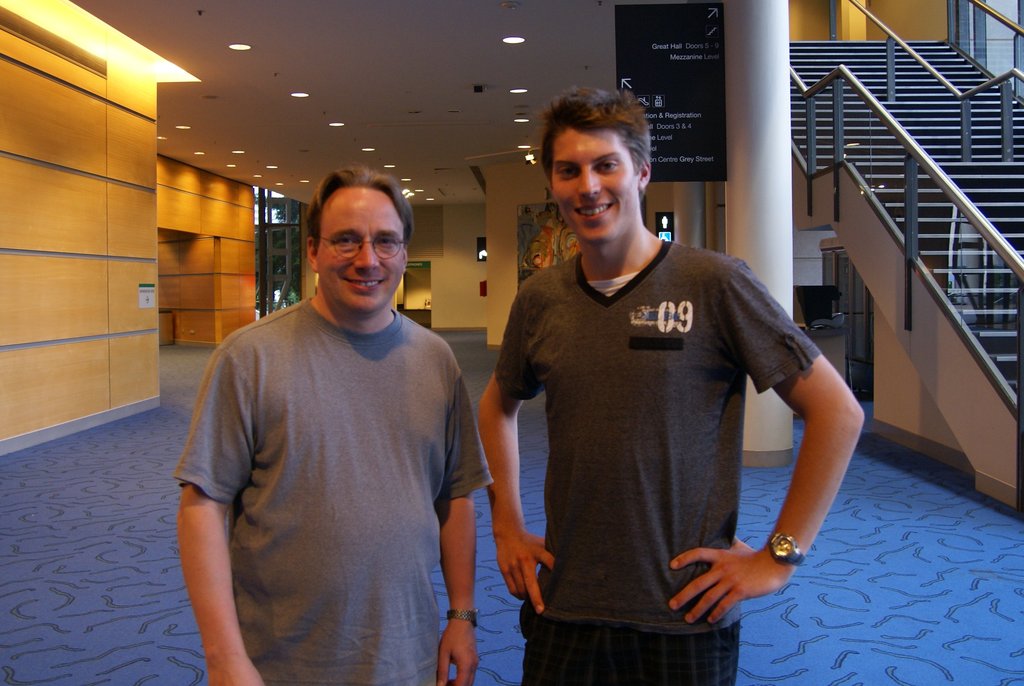
I had the honour of meeting Linus when he appeared at Linux.conf.au 2011 in Brisbane this week, and after chatting to him for quite some time I must say that this man is a lovely, amicable and approachable person who is truly passionate about what he does.

Linus is humble although what he has done has affected the day-to-day lives of millions, he is friendly and approachable although his position makes him a target for potentially annoying fanboys and media to swoon after and his insight into the world of Open Source is something that I believe should be truly valued.

On Ubuntu


In its 6 year existence, Ubuntu has delivered 13 releases into the hands of millions of users, a number which continues to grow every day. It has been fundamental in helping lower the barrier to entry for Linux and has brought many more people into the Free Software world, myself being one of these people.

So naturally, I asked what Linus thought about Ubuntu, and the first thing he said was that he is not an Ubuntu user.

“I’ve tried it a couple of times over the years, mainly because the thing Ubuntu did so well was make Debian usable. I always felt that Debian was a pointless exercise because to me, the point of a distribution is to make everything easy. Easy to install, to be pretty and to be friendly and Ubuntu did that to Debian.”

[...] the thing Ubuntu did so well was make Debian usable.

“I’ve always had a few problems [with Ubuntu.] It’s not very friendly to kernel developers, and I just end up giving up. That’s kind of okay, because clearly I am not the target audience.”

“I think that Ubuntu has done a really, really good job making Linux available to a wider and different audience, the kind of audience that comes from a Windows and Apple background.”

I think that Ubuntu has done a really, really good job making Linux available to a wider and different audience.

I explained to Linus that certainly that was the case with myself, as I only got involved with Linux a couple of years ago and if Ubuntu wasn’t around I don’t think I would have had the guts to give Linux a go.

“Even from a technical angle, I love the fact how Ubuntu was basically the distribution that started the whole Live CD install. While you’re installing [Ubuntu] you can actually use the program. You can actually do something while it’s installing and I thought, why didn’t everybody else do this?”

On Linux in mobile devices


Linux on mobile devices has come a long way in the past two years, mainly helped along by the massive force that is the Android Operating System by Google.

Suddenly, Linux is actually being used by a huge number of people around the world and with over 300,000 Android phones being sold a day, as well as other Linux based platforms such as Nokia’s Meego starting to take shape, this doesn’t look like it’s going to change anytime soon and indeed it will only get more popular.

I suggested to Linus that it must be really pleasing for him to see Linux in the hands of hundreds of thousands of people every day.

“Not just Android. What I’ve found that has been most fun for me has been when people are using Linux in ways that I don’t use it or in ways that I never intended it to be used, people using it in embedded areas, and with cellphones like Android but also all the crazy people using it in printers and TVs.”


“I am very happy about Android obviously. I use Android, and it’s actually made cellphones very usable.”

“In fact, long before cellphones became more usable there were all these failed prototypes that tried to use Linux and that was a lot of fun to see too. It’s a learning experience.”

I am very happy about Android obviously. I use Android, and it’s actually made cellphones very usable.

At that point we had to catch our bus from the conference venue to the Brisbane Cultural Centre where the Penguin Dinner was to be held.

I got to have a nice informal chat with Linus off-record during the bus ride, about everything from Australian public transport to where he had been diving that morning (one of Linus’ hobbies is SCUBA diving).

Eventually we got to the Cultural Centre and found a quiet place to continue the interview, where I had one last question to ask Linus.

Upcoming kernel features


The kernel is Linus’ domain, so I figured I better ask him what cool new stuff is happening in the next 6 months of kernel development.

“The current merge window that closed only a week before I left for the conference is my personal favourite merge window in a long time because we have two really big things going on.”

“We have the new filename lookup code. The neat thing about that is that it should be completely invisible to users in the sense that we don’t add in new features, we don’t do anything that people notice except we’re doing it much faster.”

[...] we’re doing it much faster.

“We were very good at file lookup before too because it’s a very common operation. Even when you’re using a graphical desktop and you don’t think about your workload as being filesystem specific, quite often every time you open a new graphical application they tend to open ten thousand different configuration files.”

“Sometimes it’s a disgrace what those processes are doing behind your back, and making that very fundamental kernel operation faster is something that I get involved in and I think the kernel should do really, really well.”

Sometimes it’s a disgrace what those processes are doing behind your back.

“At the same time it’s kind of the less glamorous side of the kernel. People tend to talk up new features and how we do something really cool that nobody has ever done before. The fact is in the end the really important stuff is the meat and potatoes – doing the boring stuff, the stuff that really matters.”

“Too many merge windows have fancy features. New drivers are something that everybody wants and needs and there is new hardware coming out and we need to support it, but at the same time new drivers tend to not be something fundamentally exciting, that’s the other side of the meat and potatoes, you need to do it because you need to support the hardware but it’s not the kind of stuff I personally find exciting.”

At this stage I asked Linus whether the kernel was going to continue getting faster as the kernel team work on optimization.

“I hope so, quite often the kernel doesn’t get faster. We add new features and as a result the kernel gets bigger and slower. The fact that we get noticeably faster on some really important operations is a great thing.”

I suggested to Linus that unlike other Operating Systems such as Windows, Linux tends to not suffer from the same level of bloat as time goes on.

“We have bloat, it comes up in a lot of benchmarks and a lot of people do benchmarking of how kernel performance improves over time, but we do have bloat and it happens.”

Almost always there is a really good reason for the bloat.

“Almost always there is a really good reason for the bloat. For example, we add in something because we want people to do new things but it does often end up meaning that we have a bigger footprint. Sometimes we add stuff that really speed things up so that it makes up for all the bad things!”

“Computers are getting faster and in the last three years we have improved scalability a lot. It used to be that having four CPUs or eight CPUs you were talking about server systems and relatively few people using them.”

“What’s happening now is that we’ve done a lot of scalability for those people and you can now buy a laptop with four CPUs or eight CPUs and it’s not even that expensive.”

Thanks a lot to Linus for taking the time out of his incredibly busy schedule to talk to me, I really enjoyed it and I hope you guys enjoyed reading it!

Linus and I at LCA 2011


Ubuntu powered tablets

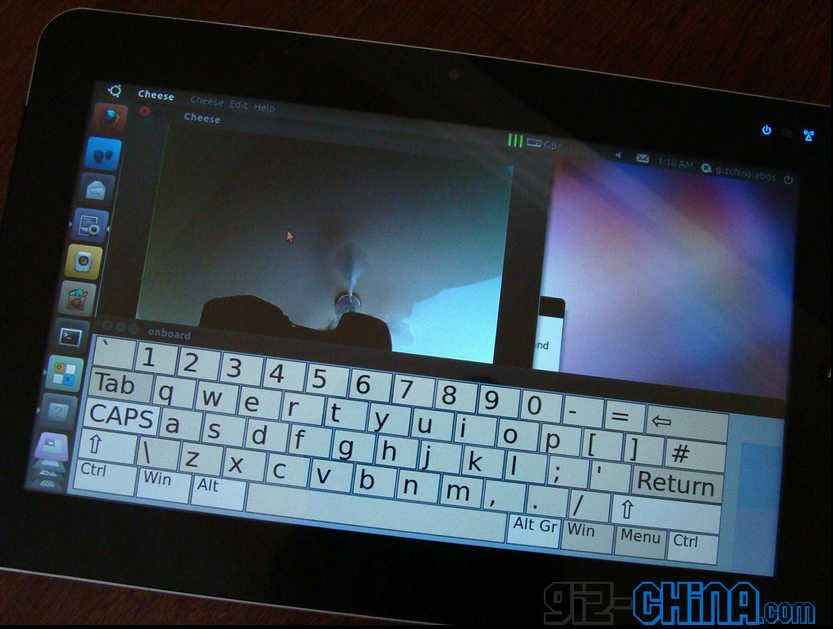
It’s hard to keep up with the slew of identikit Ubuntu tablets slipping out on to the Chinese market, but at least this one has some new information for us to digest..


image

The ‘TENQ P07′ – which we first covered in December of last year – is powered by the now perfunctory 1.66 GHz Intel Atom CPU, comes with a minimum of 1 GB of RAM and a 16GB SSD is used for file storage.

A 10" capacitive screen, 1.3MP webcam and the usual smattering of Bluetooth, Wi-Fi, headphone and USB ports round out the feature set.

The device also sports "gravity sensors" according to GizChina, with whom the hands-on video below is from. I’m not sure if they mean ‘accelerometer’ or ‘gyroscope’ or whether, indeed, it is a sensor for measuring gravity. Either way it doesn’t yet work in Ubuntu. ;) .

Pricing to start from $400 for the 16GB SSD model. Release date and market availability yet to be announced.


New sound menu of Ubuntu 11.04

Ubuntu Natty developements


The Sound Menu of Ubuntu 11.04 Alpha sees the return of play list support – an easy way to access your favourite track line-ups in Banshee without needing to open the app itself.

Screenshot-2

Elephants, or readers with good memories, may recall that this very feature was proposed for inclusion in Ubuntu 10.10 – and did begin to see implementation. Sadly various issues and rethinking put paid to both it and the track scrubber (remember that?). The final release of Ubuntu 10.10 saw neither included.


Whether or not a similar fate is beholden to the Natty version remains to be seen, but for now at least Alpha testers can play around with initial playlist support in their Sound Menu.


The latest version of lightweight webkit browser Midori has been released.

Alongside bug fixes and stability improvements version 0.3.0 sees duckduckgo.com set as the default search engine. Never heard of it? Wikipedia says: -

“[DuckDuckGo.com] uses information from crowd-sourced sites (like Wikipedia) with the aim of augmenting traditional results and improving relevance. The search engine philosophy emphasizes privacy and does not record user information.”

Other notable changes/update include:  -
  • Support for libnotify 0.7
  • Correct bookmark and search icon names
  • Better link menu handling
  • Fix Russian keyboard issues
  • Simplify language and panel options
  • Default to DuckDuckGo search
  • No Netscape plugins in extension panel
  • Easy user add-on install infobar

Download Midori 0.3.0


The latest builds of Midori are, as always, available to install via its own dedicated PPA. This also requires the addition of the WebKit PPA.
  • sudo add-apt-repository ppa:midori/ppa
  • sudo add-apt-repository ppa:webkit-team/ppa
  • sudo apt-get update && sudo apt-get install midori

Alternatively source can be downloaded here.

Related posts:
  1. Midori 0.2.9 released with private browsing, Google reader fix & more
  2. MIdori web browser 0.2.7 released – new features, new extensions, better speed
  3. Midori 0.2.6 Released – Now allows custom number of speed-dials


Source